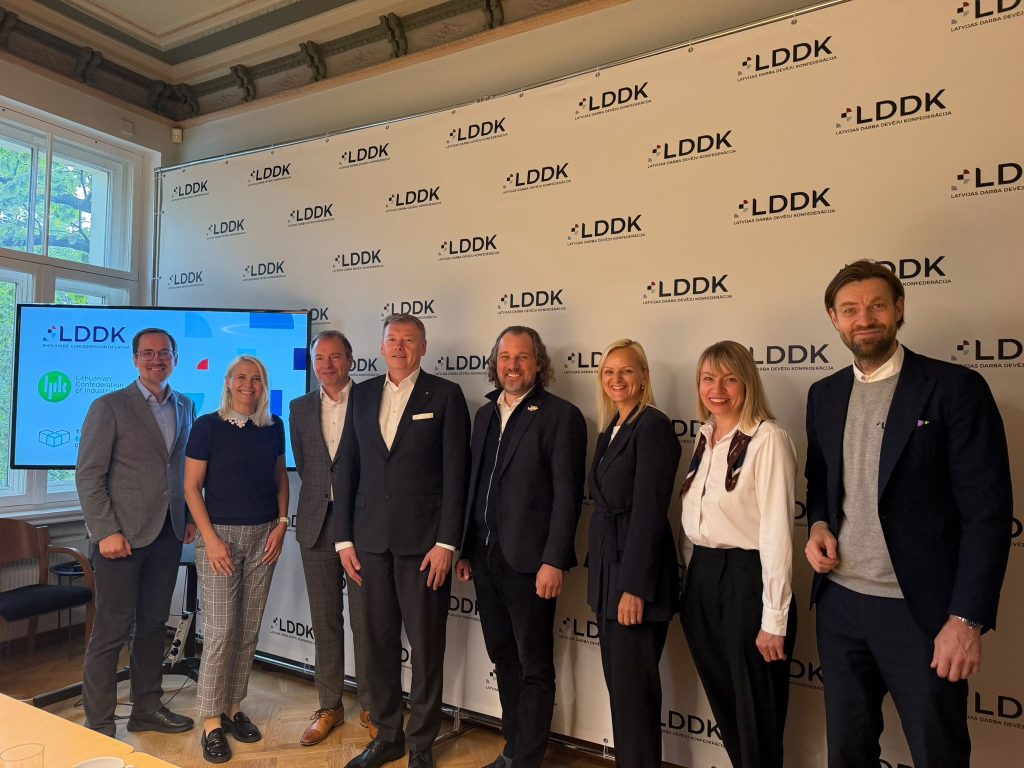
Baltic Employers Agree on Common Priorities for Competitiveness, Resilience and Security in 2026–2028
The employers’ organisations of Lithuania, Latvia and Estonia have agreed on common priorities for 2026–2028 aimed at strengthening the Baltic region’s competitiveness, economic resilience and security. The joint position, addressed to the three national governments and European Union institutions, outlines six priority areas – from involving businesses in crisis preparedness and strengthening the defence industry to ensuring competitive energy prices, attracting talent and creating better conditions for investment.
The joint position was developed by the Lithuanian Confederation of Industrialists (LPK), the Employers’ Confederation of Latvia (LDDK) and the Estonian Employers’ Confederation (ETK).
The document highlights the particular geopolitical and economic challenges facing the Baltic States as part of the EU’s eastern flank. Their relatively small domestic markets, shallow capital markets and high dependence on international trade increase the region’s exposure to external shocks. Strengthening the Baltic economies therefore contributes directly to Europe’s security, industrial capacity and resilience to crises.
“The Baltic States share the same strategic challenge: we need stronger economies to strengthen our security, and greater security to create the conditions for investment and growth. This requires closer Baltic cooperation, better access to European and private financing, competitive energy, stronger defence and industrial capacity, and a business environment that allows companies to invest, innovate and scale. Ahead of Lithuania’s EU Council Presidency, we should turn these shared priorities into concrete European action,” said Vidmantas Janulevičius, President of the LPK.
Six Common Priorities of Baltic Employers
- Strengthening economic security and involving businesses in crisis preparedness.
- Giving greater attention to the EU’s eastern flank in the next EU budget.
- Building a Baltic Defence Zone and expanding defence industrial capacity.
- Developing strategic infrastructure and ensuring competitive energy prices.
- Raising productivity and attracting talent.
- Making the Baltics Europe’s most attractive place to invest, innovate and scale.
An Opportunity to Turn Priorities into Concrete EU-Level Action
The Baltic employers’ organisations intend to actively advance the joint position with their national governments and EU institutions. Lithuania’s Presidency of the Council of the European Union in 2027 and Latvia’s Presidency in 2028 are seen as important opportunities to translate these priorities into concrete policy decisions.
The organisations also emphasise the importance of closer cooperation with the Nordic countries, Poland and other regional partners, particularly in implementing strategic infrastructure, defence and industrial projects.
Baltic employers will discuss further steps to advance the common priorities at their next meeting, to be held in Lithuania in April 2027.
Read the full joint position: “Baltic Employers’ Priorities for European Competitiveness, Resilience and Security 2026–2028” (PDF)